
Mr Iyengar: In the presence of a living legend

A funny conversation in a shopping centre
Yesterday early evening I was in a shopping centre in the suburbs of Pune making the most of the free wifi. I sat on a comfy sofa having a chai listening to Rhianna sing about umbrellas again. A young Indian guy asked me if the seat opposite was free. He couldn’t have been more than 20 and soon introduced himself as Dave. This is the conversation we had:

Dave: Where are you from?
Me: London England (a well rehearsed response)
Dave: I have a friend studying at Kingston. You know it?
Me: Yes. [I keep head down, tapping on my iPad trying to stop yet another Indian guy talking to me]

A few minutes later…

Dave: Why are you sitting here in this shopping centre?
Me: There’s a yoga place around the corner that I wanted to visit – the Iyengar Institute.
Dave: Oh I think my mum used to go there.
Me: Your mum went there? She studied with Iyengar? Wow, that’s amazing.
Dave: Is it?
Me: Yeah. You have to have been studying Iyengar yoga for eight years just to get in there. BKS Iyengar, the man behind Iyengar yoga, he started it there. Just a five minute walk from here. I went there this afternoon and sat in on a class he was teaching. People from all over the world come to study with him… and your mum went there!
Dave: Oh ok. She has been doing yoga for years. So what clubs do you go to in London?
Me: I don’t really go clubbing much.
Dave: What?! You live in London and you don’t go clubbing? There’s some of the best clubs in the world there.

[I smiled and then carried on typing on my iPad.]

A few minutes later he tried again…

Dave: Where are you staying in Pune?
Me: Koregaon Park.
Dave: You’ve come all the way here from KP? That’s so far!
Me: It isn’t really. People travel a lot further to study with Iyengar.
Dave: Have you been to any parties or clubs in KP? All the best ones are over there.
Me: The only dancing I’ve been doing is in a maroon robe, in a place where people follow Ming the Merciless.*

* I would have loved to have said this out loud but the poor boy already thought I was a nutter. See my previous post if this doesn’t make any sense to you.

Isn’t it funny how people can be motivated by such different things. He’d visit my country to go clubbing, I’d visit his to do down-facing dog.

I witness Mr Iyengar in action
Let me tell you about my experience that afternoon with Mr BKS Iyengar or ‘Guruji’ to his students. For those yoga virgins out there, BKS Iyengar is one of the great grandaddies of yoga. He’s 93 and his impact on yoga cannot be underestimated. A lot of yoga taught throughout the world is influenced by Iyengar – with its focus on alignment and the use of props such as blocks, bolsters and straps – and Iyengar classes are very popular.

He set up the Ramamani Iyengar Memorial Yoga Institute in Pune in 1975 and you must have been studying Iyengar yoga for eight years to be considered for a place.

I turned up and was greeted by a kind-faced middle-aged lady. She started telling me how I couldn’t take any classes but I stepped in to say that I was in Pune and I just wanted to look around if possible. “Of course! You have done a very good thing,” she beamed at me. “Let me just finish my tea and I will give you a tour.”

I sat gawping at trophies and awards in cabinets. The walls were full of photos of Guruji, certificates, newspaper and magazine articles and photos of groups of students in baggy t-shirts and small shorts that had elastic around the thighs.

“Ok, we go”, she said, placing her teacup onto its saucer for the final time. I followed her through a corridor past yet more pictures. We went up a curved flight of stairs and she told me to sit on them. The staircase was open and, once I sat down, I had a full view of the semi-circular practice hall.

20121025-140832.jpg
The lady told me that a remedial class was taking place and that I could stay and watch for as long as I liked. There were probably 30 students in the space along with a staggering array of wooden blocks, stools, bolsters, cushions, metal bars and ropes hanging from the walls. Around the top of the semicircle were row upon row of black and white photos of a young Iyengar in asanas.
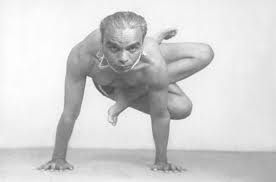
20121025-140921.jpg
People busied themselves putting others into postures and there, at the front perched on the edge of a platform was the great man himself. The lady pointed out his daughter – a middle-aged lady who hobbled around in an orange sari, and his granddaughter – a well built girl in high-waisted lime green shorts, t-shirt, and a long black plait down her back. Both she and her mother were kept busy taking instructions from Guruji, putting a man with bandaged legs into various asanas.

I couldn’t take my eyes off him. He was smaller than I imagined and did not look all of his 93 years. White hair trailed down to his shoulders and his eyebrows looked like clumps of cotton wool. He wore a white lungi and a white grandad shirt.

20121025-141023.jpg
He coughed often and looked frail but you would never mess with him. It was lovely to see the bandaged man touch his feet as a sign of respect. Guruji batted him away.

I watched the class for about an hour. I have never seen so many props in an asana hall. The man was put into savasana with three rows of three bolsters placed down his bandaged legs plus weights – at Guruji’s strict instructions. Throughout the hall students were in different poses, working in twos. They were hanging upside down in ropes on the walls, lying on their backs with legs through chairs, dangling in various supported backbends… you name it, they were doing it.

It was great to see people doing some of the things that Michel did with us on our teacher training. He has studied at the Institute with Mr Iyengar.

Guruji then looked at the clock and got up to leave. His granddaughter was instantly at his side and led him out of the room. People were told they had time for one more asana. Soon after, I left and found myself chatting to Dave in the shopping centre.

I felt so blessed to have been in the same room as Guruji. Even at his age, he was so in control, knowing exactly how he wanted the props set up and the energy in the room was buzzing. It was such a special experience and one I’ll remember for the rest of my life.

And I’m sure he looked at me on at least one occasion…

Osho’s ashram: One sneeze and you’re out

“When you’re doing Gibberish, make sure you really are talking gibberish. I was next to someone the other evening and they were making animal noises! I’m naming no names but they really should have known better.”

That’s a taster of the wisdom that was imparted to us 20 or so Osho newbies on our first morning. By this point we’d paid our £12 registration fee which included a compulsory HIV test, bought our maroon and white ankle-length robes and paid a further £12 for a day pass. We’re talking thousands of Rupees here.

“Why Wener?!” I hear you ask. Because I first heard about the Osho International Meditation Resort on a visit to the Sivananda ashram in Kerala four years ago. Some people rave about the place whilst others such as Lucy Edge in her book ‘The Yoga School Dropout’ have been less enthusiastic. One friend of mine – who shall remain nameless – said that she isn’t brave enough to visit the place. I was intrigued and wanted to experience it for myself.

The man behind the myth
The Lonely Planet states that Osho (1931-90) was one of India’s most flamboyant and controversial exports to the West. Having spent years studying philosophy, his ‘methods’ are a way to break down our habits and social conditioning. He enraged many by making outrageous comments about pretty much every world religion. In 1981 he set up an ashram in Oregon, US, but got deported and sought a home for himself and his followers overseas. He found his base in Pune after being denied entry or being deported from 21 countries. He amassed a collection of Rolls Royces and one sits in his former home. You take your shoes off next to it as you enter his house to meditate.

Why ‘sex guru’?
According to Osho, sex is a way to enlightenment. Unsurprisingly, this theory has made him very popular in the West. Apparently in the olden days of the place (1990’s), everyone would be sweaty after the morning meditation, jump in the mixed showers and you’d be having sex with someone before breakfast. Times have changed and the place is very different now. It felt all very organised and sedate. Although I think it’s still there if you want it. I didn’t see much of that going on… or perhaps it was because I was so focused in my meditations. Ha! Fat chance!

Breaking the rules
The Welcome Morning allows you to become familiar with the place, its activities and ensures you don’t make any major faux pas. Within five minutes of arriving, our bubbly Korean host Su Yee had us jumping about and forgetting ourselves. She’s lived there for eight years.

Despite the morning, I still slipped up in the canteen on day two. I put rice straight onto my plate instead of in a bowl. Outrage!! The serving staff were quick to reprimand me and an Indian man was onto me, gesticulating and speaking in Hindi. Svargo, an English guy who’s been visiting since 1988, fortunately came to my rescue (“Yeah, yeah, she gets it. She won’t do it again…”).

As for other rules, if you coughed, sneezed, burped, farted or made any other seemingly involuntary noise during a silent part of a meditation, you had to leave the room. The booklet says: “If the cough or sneeze happens too quickly, then at least leave immediately afterwards. Please don’t wait for someone to have to ask you to leave.” Oooer.

I heard one woman try so hard to stifle a coughing fit that she made twice as much noise as if she’d just coughed. She ran out of the room disgraced. She never returned.

Any noises were amplified by the black marble floor in the main Auditorium. It was so highly polished you could see people’s reflections. It was stunning and so peaceful. In fact, the whole place was beautiful.

20121023-182255.jpg
(The Auditorium inside and out)

20121023-181848.jpg
The resort was very Zen with small black pebbles, pools of water, white marble Buddhas sitting amongst carpets of green. Bamboo gracefully creaked in the wind and the buildings were black and shiny. Water fell down walls of slate and people swam in the dark pool (in maroon swimwear). The fact we all wore maroon added to the aesthetics of the place. If we’d been wearing our own clothes, it would have jarred with the surroundings and not been so peaceful.

I spent the first day walking around with my mouth hanging open.

The meditations

Evening Meeting of the White Robe Brotherhood
The highlight of each day was the evening meeting in the Auditorium. People changed out of their maroon robes and into crisp white ones.

The meeting had various stages:

1. Celebrate through dance: I’d say there were about 500 people in the evening meetings and this is the low season. Standing in the Auditorium, the live band would start up. The music slowly gained momentum and became hypnotic. People really went for it. Guys were Sufi whirling, spinning at speed with their arms outstretched. I’ve never seen men dancing so intently. People were all over the place, arms flailing and totally lost in the music. It was really good fun. I danced so hard that I couldn’t see straight. At times the music stopped and everyone had to stick their arms up in the air and shout “Osho!”.

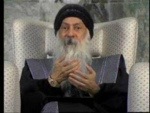
2. Osho speaks: On a projector appeared the man himself. There aren’t pictures of him around the place so this was the first time I saw him. Behold a man with a woolly hat, a beard down to his chest and an outfit that strangely reminded me of Ming the Merciless. We’d been told by Su Yee that we might not understand much of what he says. This was correct. He stretched words out so much and it was all meant to be a method to keep you alert. Examples: “consussneeeeece” “relijeeeen” and “lotussss”.

20121023-182010.jpg
(If only Ming wore a woolly hat…)

20121023-182052.jpg
He’s fond of a joke. Some are funny, some aren’t. I liked this one:
A wife says to her husband: “You remind me of the sea.”
Husband: “Is that because I’m so magnificent, strong and wild?”
Wife: “No. It’s because you make me feel sick.”

I think he wove them into his discourses in order to keep you awake. One guy stopped snoring when we all started laughing.

3. Gibberish: In the booklet we were given, Osho says:

“Shouting, laughing, crying, making noise… making gestures. Simply allow whatever comes into your mind without bothering about its rationality, reasonability, meaning, significance. Do it totally with great enthusiasm… make it a reality… just go crazy. Don’t be partial, don’t be middle-class. Just be a first rate crazy man!” “If you don’t know Chinese, say it in Chinese!”

My English sensibilities kicked in and I felt a bit uncomfortable.

4. Sitting silently: I can do that.

5. Fall down ‘like a bag of rice’: Su Yee imparted a handy tip to allow us to fully submit to this stage. We had to move forward on our mat/rug during Gibberish so when the drumbeat came, we could collapse backwards safe in the knowledge that we weren’t going to knock ourselves out on the marble floor. Invaluable.

6. Celebration through dance: Thumping music. Then the music finishes and everyone gets up, walks out, puts shoes on and leaves silently.

Other meditations

Every afternoon is the OSHO Kundalini Meditation. It starts with shaking. “Be loose and let your whole body shake. Become the shaking,” says Osho. On day two, the shaking definitely became me. It’s like you’re doing an impression of someone having an epileptic fit. You then do dancing, sitting and a nice 15 minutes of savasana.

The Dynamic morning meditation had so many stages. The most memorable was standing with your arms held straight up, you jumped up and down with flat feet (killer on the calf muscles on a marble floor) whilst shouting “Hoo! Hoo! Hoo!” We did a test run as part of the Welcome Morning and people had to attempt it standing in front of everyone whilst Su Yee corrected the shape of our mouths when ‘hoo-ing’. It’s a precise art form for sure. She’s had eight years to perfect it.

I liked the OSHO vipassana meditation because it felt familiar. Osho would probably say that it isn’t the best one for me because of this. We sat in silence for 45 minutes observing flow of breath and then 15 minutes of walking meditation. When sitting, I loved how a woman came around and donked you on the head with ‘the vipassana stick’ to keep you alert.

Why?!!
These activities were all designed by Osho to break down our conditioning. We need to remain fully alert. We mustn’t live in our body or mind, but instead, just witness our thoughts. If we feel uncomfortable, it’s probably because it fights against our habits and deep rooted behaviours.

However…
The opulence of the place didn’t sit well with me. Why did Osho need Rolls Royces? Why was it so expensive? Who needs Osho-branded sugar sachets? Surely it’s just a playground for the rich? There was a 50:50 split between Indians and Westerners but if it was more affordable, I would have thought that more people could benefit. It was an oasis totally at odds with the mad India going on outside.

I felt guilty walking past the Indian women sitting on the street trying to sell me pashminas and t-shirts costing a fraction of the daily entrance fee. They saw me walking out of a place where I’d spent a small fortune to jump about like a loon. How could I say that I didn’t need their things?

I guess I felt I could connect with the experience by the end of the second day. I’ve done expressive dance before and the more you do it, the easier it gets. Jumping up and down with flat feet shouting ‘hoo’ is very unfamiliar and therefore scary. But as the old adage goes, you shouldn’t knock something until you’ve tried it. I tried it for two days and it was alright. The people were friendly and, if it was cheaper, I may have stayed longer.

But I won’t miss the hoo-ing. Or the Gibberish.

Mumbai: Ummmm… bye!

I’m leaving Mumbai later today to go to Pune but let me tell you about what I’ve been getting up to.

Rich pickings

Walking along Colaba Causeway to eat at Leopold’s Cafe (for anyone who’s read Shantaram…) and a beggar lady in a beautiful sari starts saying to me, “Madam, I need rice for my children to eat”. She walks just a little in front of me. I try to shake her off by stopping but she sees me and soon catches on. It’s a narrow street and there’s lots of people. At one point I stop abruptly and a boy walks into the back of me. I hug my bag to my front. I stop again and he walks into me again and the lady catches his eye.

He’s trying to pickpocket me! They’re setting me up! The buggers! They fail.

“Madam, a slight problem in your room”

I come back to my vastly improved hotel and the guy on reception stops me saying the above. He opens my room door and explains that, while I was out, part of the ceiling collapsed directly over my bed. There’s a huge hole covered from above by a sheet of MDF. “We change the sheets and clean. Everything ok?” Hilarious.

20121020-110531.jpg

Slumdog

I go on a tour of Dharavi, Mumbai and Asia’s largest slum. It’s where some of the Danny Boyle film was shot and it’s amazing.

Five of us and a guide spent the afternoon walking through tiny dark alleyways with kids squeezing past us, peering into workshops only to see a room full of guys in string vests smiling back at us, and standing on rooftops surrounded by mountains of plastic split by colour. The slum is home to one million people and covers only 174 hectares. It originally was swampland but people have been living there since the 1840’s.

What impressed me most was how organised it was. There are distinct areas for different industries including clay pottery, plastic recycling, metal can recycling, leather and handbag-making, and heavy industry with sparks flying. The residential area is separate with the divide marked by a rather smelly river. Unemployment and crime is low although diseases such as cholera and malaria keep the numerous health centres busy.

We watched bakers producing goods to be eaten as far away as Afganistan and men behind old singer sewing machines making leather jackets to be sold by the brand ‘Lee’. The recycled plastic is used in electronics by companies such as Samsung. The guide quoted these companies to demonstrate the quality of the work carried out in Dharavi. Their company profits must be astronomical.

We learnt that tax evasion is the biggest crime and that each toilet is used by over 1000 people. The average income is around £1.50 a day and, due to demand, it costs around £50 a month to rent a tiny room. There’s often four to six people per room. In this space they cook, eat, wash, sleep, watch TV and often have the internet. And I thought my studio flat was small.

The tour was carried out sensitively and you didn’t feel that you were intruding – or that you weren’t welcome. No photos were allowed and 80% of the tour cost goes towards local community projects. I’d highly recommend it. Visit www.realitytoursandtravel.com for more information.

And finally…

It’s Navratri here in India. That means nine days of festivities in streets covered by canopies of fairy lights. It celebrates the Hindu goddess Durga and ‘Navratri’ literally means ‘nine nights’ in Sanskrit. Each night, different forms of the divine mother or ‘Shakti’ or ‘Devi’ are worshipped. It’s a big deal in Mumbai.

People dance every night to live bands and I even heard Ganga Arati, taking me back to my Sivananda teacher training on the banks of the Ganges. We had to chant it twice a day. There’s a wonderful atmosphere.

See you in Pune, the land of Iyengar yoga and the sex guru Osho!

Welcome to India

I have just spent my first night in Mumbai. This is my fourth time visiting ‘the motherland’ but I think arriving in India is always a bit of a shock.

My flight landed 30 minutes ahead of schedule at just after 11pm but any advantage dissipated when I saw the queues after the luggage collection belts. Every piece of luggage had to go through a scanner and flights from London and Dubai had also just landed.

Cue well-dressed London types obviously there for work muttering and stomping plus mustachioed Indians returning from stints in Dubai standing way too close together whilst lugging huge well-labelled bundles wrapped in plastic sacking and metres of rope.

You’ve got to love an Indian process. Indians certainly do.

I told my prepaided taxi man that I was going to the Salvation Army guesthouse in Colaba and typically he said he didn’t know it. Even when I said the road name, there was a distinct lack of comprehension. So off we set for Colaba and I hoped for the best.

The thing I will remember about the journey were the hundreds and hundreds of people I saw sleeping on the streets – at the side of the three-lane motorway, on traffic islands, on pavements and shop fronts. They were even asleep outside entrances to mammoth glass and steel office buildings. Call centres?

There were entwined couples snoozing, groups of ten or 20 people lined up along pavements, and children huddled against their parents. Some slept on newspaper, others on cardboard or matting and some had pillows of clothes.

It was the sheer number of people on the streets that overwhelmed me. I remember seeing people sleeping on a grass verge when my Dad and I were getting an early morning train to Shimla a few years ago but it didn’t compare to this.

My taxi was typically honking his horn every five seconds and lorries were steaming along but they all looked dead to the world. Their clothes were dirty and very shabby and they needed a good meal.

I directed my taxi driver to the guesthouse (slightly ironic) and he dropped me off by big wooden doors. I knocked and a grumpy Indian bloke opened the doors: “We are full.” I explained that I’d emailed and reserved a room and I showed him an email on my iPad.

Turns out there were no double rooms left so he gave me the key for a family room and went back to bed: “You change room tomorrow morning.”

The place was like a nineteenth century asylum. It was 1am by this point and my footsteps echoed up the stone steps. The ceilings were high and the paint was peeling off the walls.

I found the door to my room – tall double doors sealed with an ancient padlock. I turned the key, slid the bolt and the doors creaked open. I had to get my torch out as I was scared to go into the dark abyss.

I was greeted by five metal rusty bed frames, peeling paint, crumbling plaster, old mattresses, a sofa that you’d only see as fly-tipping at home, and biro scrawled over the walls. The bathroom light didn’t work which was probably a blessing as wires stuck out of the stained yellow walls. It was a hovel. A pile of crumpled sheets sat on a mattress. I had no idea if they were clean or dirty. And they had burn holes in them.

I mean, I’d read online that it was hard to find budget accommodation in Mumbai but I was paying £12 for this privilege. Let me put that into perspective – the plush dorm at The Sanctuary on Koh Phang An cost half the price.

I started thinking about bed bugs and had the brainwave to put my yoga mat between the mattress and the sheet. Check-out was at 9am but I think Usain Bolt would have had trouble keeping up with me this morning.*

I found a place nearby and I now have views of the sea, the Gateway of India AND it’s cheaper than the madhouse.

I’m now sitting in an air-conditioned cafe earwigging young Indian women with pearl earrings having business meetings over coffee.

Welcome to India indeed.

* Had to Google who won the 100m at the Olympics. So out of the loop…

An unfortunate incident on a Sri Lankan train

This is my fourth day in Sri Lanka. Up until today I’ve been staying with my Sivananda teacher training buddy, Sherylee and her husband, Brett on the south west coast in Hikkaduwa.

Sri Lanka feels like a good stepping stone between Thailand and India. From what I’ve seen so far, it feels like a sleepier, more laid back version of India. You’ve got the mad drivers, signs that you can’t understand, dust, and the Indian shaky head, but it’s far less Western than Thailand. I haven’t heard Adele’s ‘rolling in the deep’ once.

Sherylee and Brett have lived in Hikkaduwa for the past six years and in that time, they’ve adopted (or been adopted by) four beach dogs and two weeks ago they moved into an impressive house that they’ve designed themselves. Kevin McCloud would be proud. Once they get some furniture it’ll be even more amazing. When Sherylee and I were last together on our teacher training in 2010, we ate sitting on the floor for a month so it was just like the old days.

This morning I jumped on the back of their motorbike and Brett dropped me off at Hikkaduwa train station. I love foreign train journeys and the plan was to take a two-hour train to Colombo and then catch another train for three and a half hours inland to Kandy in hill country.

I arrived here a couple of hours ago and I want to tell you about the journey.

The trip from Hikkaduwa to Colombo was fine. It was a modern train and I got a window seat. We clackety-clacked along the palm-fringed coast and I ate the bananas and apples Sherylee thoughtfully gave me for breakfast.

I had 40 minutes at Colombo and my greatest achievement during that time was managing to use a squat toilet with my big rucksack on my back and my small rucksack on my front. From assessing the floor of the cubicle, there was no way anything was going near it apart from the soles of my flip flops. I also managed to keep the wooden door closed by hooking my index finger through a hole in it. Success.

The train to Kandy was full but fortunately I managed to get a window seat again. Around me were families with babies and young couples. As with Indian trains, people hung out of the doors along the sides of the train and sat on the door steps looking straight onto grassy verges, ramshackled wooden huts and lush paddy fields.

As we clattered along, the driver honked the horn alerting people walking on the railway line that the train was coming. I could feel the searing sun on my forearm and I bought drinks off the men walking through selling their wares. When passengers bought greasy fried food, the sellers would scoop it out of their baskets and put the food in little bags made from recycled notepaper. I could see schoolchildren’s algebra homework becoming big oily blobs as passengers munched away.

A group of teenage boys with their hockey kits boarded my carriage and occupied the entrances at either end. They called to each other and I was in between, looking out of the window. As we snaked up and away from the humid plains, we passed through dark stone tunnels and the boys shrieked and whistled, laughing at the echoes.

20121020-104941.jpg

They became braver and braver, leaning forward out of the doorways and waving at their mates further down the train. As we pulled out of stations, they’d wait until the very last moment to jump back on the train. I started thinking that this was how accidents happened.

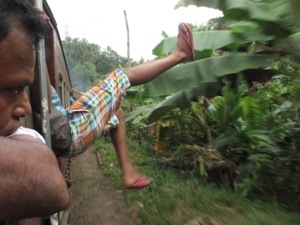
One boy in particular was very bold. He’d hold onto the rails on either side of the doorway and bring his leg out to 90 degrees touching the tall grass at the side of the tracks. At times, he’d bring his leg back only a fraction of a second before a train signal post or tunnel. He laughed and joked and I gave him stern looks. I couldn’t watch.

20121019-210515.jpg

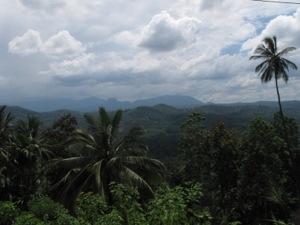
The views were breathtaking. It got cooler and the rolling hills went on for miles. At every station, it would say the height above sea level: 200m… 360m… 440m… up and up.

20121020-105158.jpg

About 15 minutes outside of Kandy, the boy was still larking about, calling to passers by on the tracks. And then the train horn sounded. And kept going. We came to an abrupt screeching halt.

The boy suddenly appeared inside the carriage next to our seats. He was crying and burying his face in his hands. His friends gathered around him.

I leant out of the window and people were frantically running back along the tracks. I saw a mound of brightly coloured fabric next to the wheels, one carriage back from mine. I felt icily cold as I watched what looked like a bundle of clothes be scooped up and placed on the path alongside the tracks. It was a woman wrapped in a sari.

Passengers gathered around and people shouted in Sinhalese. Locals ran towards the tracks with panic etched on their faces. I asked the man sitting opposite if she was dead. Apparently she had head injuries and her foot was badly hurt. The train lurched forward and before we knew it, we arrived into a wet Kandy station.

As the man opposite me rightly said, she’s likely to feel the effects of today for a very long time. It made me think how fragile our lives are. Some of us think we’re invincible. I don’t know if the boy played a part in the accident but he had a very good view. He was rather quiet after that.

It’s raining and I’m at my guesthouse thinking about the lady and how yogis believe that you’re born with a set number of breaths. When you’ve taken these breaths, that’s it. Your number’s up. She must have a few more to go.

But you’ve certainly got to make the most of every moment. And on that note, apparently there’s a lovely Ayurvedic treatment place not too far from here…

Top 10 Thailand

I’m currently in Sukothai, half way between Chiang Mai and Bangkok. Sukothai dates back to the 13th century and was the ancient capital of Siam. There’s temples to rival Cambodia’s Angkor but today it’s raining and I’m sitting in a cafe thinking about how this is my penultimate day in Thailand.

Yes, the end is near! I am leaving for Sri Lanka on Wednesday. I was only meant to be in Thailand for two months but one thing led to another and I’ve been here for three. I’ve compiled this top ten Thai things that I’ll miss.

1. Dodgy car stickers
Seriously, why would Thai people feel a need to dissuade others from certain activities in their cars by using stickers? Take this example on a privately owned vehicle:

20121008-114937.jpg

From left:
– No smoking is fair enough.
– English readers may think the next image suggests no in-car conker matches. But no, this refers to durian fruit. A stinky, big, prickly fruit that people seem to either love or hate like marmite.
– And onto no sex.
– No weapons allowed in this car… because it’s naturally ok to have them in any other car.
– Now it gets very interesting. Does this suggest that women aren’t allowed to whip men in this car? But can a man whip a woman? It’s all very Fifty Shades. When I was doing my teacher training on Koh Samui, Abu Debbie and I hired a taxi to go to the visa office. It displayed a sticker that crudely told passengers that oral sex was off the menu.
– The final one baffles me totally. No livestock? No hypnotised animals? Answers on a postcard please.

2. Smiley happy people
I would say that nine times out of ten, if you smile at a Thai person, you’ll get a smile in return. You can’t guarantee that they’ll have any teeth, but it’ll be a big beaming smile. The people are so welcoming and if you look lost (like I did in Chiang Mai’s bus station the other day), they’ll ask you if you need any help.

3. Things that go bump in the night…
I talked about the night time noises when i was first at The Sanctuary in July. That was in the jungle but even in Chiang Mai, a bustling city with close to a million people, there was a resident vocal bullfrog that I’m sure was sitting next to my ear as I tried to sleep at night.

4. Hello you want massaaage?
If you’ve been reading my blog regularly, you may have gathered that I’ve really enjoyed getting massages here. They’re so cheap and so good. Who would have guessed that I would end up doing a Thai massage course . And who would have guessed that it’s so difficult to do well. I take my hat off to all the Thai ladies who have massaged me over the past few months.

5. Hopelessly devoted
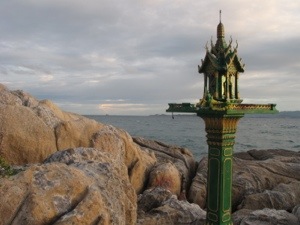
Thailand is a devout Buddhist kingdom. There are shrines everywhere – at the sides of the road, on top of hills, outside wreckers’ yards, and outside people’s homes. On shrines are offerings including flowers, cans of beer, plates of food and incense.

20121008-120915.jpg

On my bus ride to Sukothai, we passed a giant gold statue of a meditating monk perched high on a hill. It must have been about five stories tall. As we approached, the bus driver honked his horn and he and all the passengers brought their hands to prayer at their foreheads, bowed, and ran their fingers through their hair. Even the bus driver. Fortunately we were going straight at the time.

And it most definitely is a ‘kingdom’. Man alive, they love their King and Queen. They are everywhere. The national anthem is played twice a day on the radio and you’re expected to stand for it. Stepping on a coin is sacrilegious as you’re stepping on His head. If you’re Thai, it’s likely that you’ll have a photo of them above a doorway in your home and their image sits alongside those of Buddha on altars.

6. Dude looks like a lady…
Nowhere in the world have I seen such convincing transgendered people. I think I’ve used the correct terminology there. Here is a photo of me in Chaweng with a beautiful young lady. I told him that he had better legs than me.

20121008-120734.jpg

And of homosexuality, when my sister Katharine was with me, we went for a massage at a place run by a bloke from the West Country and his Thai wife. He was telling us that apparently 30% of all Thai men are gay. He then started talking about hormones and why levels of oestrogen may be higher in Thailand but he lost me there. Basically there aren’t enough men to go around and that he’s had Thai women asking him if he wanted a second or ‘lesser’ wife.

7. Beach and boats
When I was growing up, Katharine would talk about wanting to visit ‘see-through sea’. I was so happy to spend two and half weeks looking at the stuff with her. The sand was white, the sea was warm and crystal clear.

I also have particularly enjoyed arriving on these beaches on beaten-up, brightly painted longtail boats. The boat speeds into the shallows and the driver cuts the throaty engine. Whilst bobbing on the gentle waves, you jump over the side into the water and lug your stuff off the boat. You then have to wade ashore trying to look as graceful and elegant as possible with wet shorts whilst avoiding stepping on the occasional stones on the sea floor.

20121008-121201.jpg

8. Scooters
Scooters are the life blood of this country. Everyone drives one… normally at the same time. The cities are very two-wheeled friendly (as I discovered in Chiang Mai) and people also manage to earn their livelihood from them. Some have umbrellas and food stalls attached and owners set up shop and start cooking wherever they fancy.

9. Did someone mention food?
Oh the food. Where to begin? Probably with a fried egg on top. Whatever you order – be it pad thai, yellow/green/red curry, tom yam soup, noodle with cashew nut, sticky rice with mango, banana in coconut, black rice pudding… sorry got carried away there. Where was I? Oh yes, everything’s better with an egg on top.

10. Pleased to meet you…
And last but by no means least, I have had the pleasure of meeting so many wonderful new people. Even back in July and going to yoga classes with Aurore, Julie and Mathieu at The Sanctuary – that was just the start.

My time on Koh Samui was truly awesome because of the great yogis with whom I shared the experience. I love you all. I well up just thinking about it.

I had the chance to meet more people back on Koh Phang An, and Jay, a Mancunian urban radio DJ and vortex and reiki healer, stands out for sure.

My time with Katharine was brilliant and thanks to my seven massage buddies and Dot Po in Chiang Mai. It was a giggle and at times rather ragdoll-ish.

And so on to Sri Lanka! I have a week there where I’ll catch up with my Sivananda teacher training room mate, Sherylee, and then onto India until just before Christmas when I’ll fly home to London.

Have you been to Thailand? Any thoughts or memories that you’d like to share? Just enter your email address below to post a comment.

Massage school – week two

20121002-224454.jpg

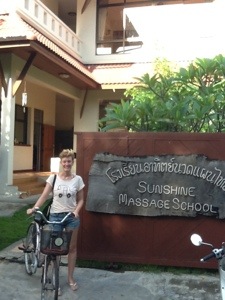
I must say that I’m enjoying my Sunshine Massage School experience. I’m also enjoying the studying and the daily routine that goes with it. It feels like I’m actually living in a foreign city.

Every day my alarm goes off at 7am, I do my yoga practice, make some toast and a cup of tea then head out for my daily commute to school.

I’ve hired a bicycle! “Not that unusual” I hear you say. Now let me tell you that the last time I did any cycling on roads was during my Cycling Proficiency Test at Church Hill Primary School. Ok, so it was in my last year, but Gallants Farm Road in East Barnet doesn’t really compare with tackling the mayhem of Thailand’s second largest city. At least they drive on the left.

Picture this: There’s this moat that encircles the old city and a dual carriageway on either side of it. Think London’s North Circular. To get into the old city, you’re on the dual carriageway surrounded by hoards of scooters, tuk tuks and songtaews (little jeeps that pick people up). You have to cross the moat by scooching into the right (ie fast) lane and then whizzing over intermittent bridges over the moat and directly into the oncoming fast lane. Then you do a left off the dual carriageway. Not easy at all. But so far so good!

Oh and traffic lights? What traffic lights? Whole families on scooters just nip across where there’s a gap in the traffic. They seem very adept at it and car drivers are very accommodating of all these two wheelers everywhere. I just pootle along sitting very upright on my squeaky Raleigh, map close at hand in my basket. Even the old blokes cycling rickshaws manage to overtake me. Their calf muscles are a sight to behold.

There’s cobblers (complete with sewing machines) sitting on the pavement and I pass street food stalls selling all sorts of weird and wonderful things. You can buy a bag of fruit for 12 Baht (22p) so I sometimes stop at her stall or there’s always the Thai favourite: 7 Eleven. It beats the District Line, that’s for sure.

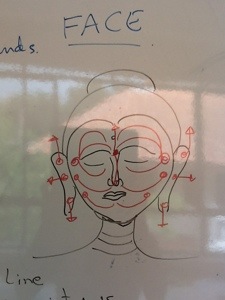
Today at school we focused on The Face. All of us took turns to run fingers over temples, rotate thumbs on closed eyelids, stick fingers in ears, do ‘the hair shampoo’ and hold chins. You should have seen us afterwards – hair sticking out at right angles, looking totally spaced out. Bliss.

We’ve now learnt all the moves for a basic Thai massage and now we just have to remember them. We’ll spend tomorrow and Thursday practicing and then we’ll be tested on Friday.

There’s so much to remember – not only the strict order of the body parts, but what things you do to them, how you get the person into the position and just as hard is remembering how you’re meant to be positioned.

And I’m teaching yoga there! There’s a free class taught by one of the tutors and he’s asked me to teach. I haven’t taught for months and it’s so nice to start sharing Michel and Roslyn’s knowledge.

In the evening, some of us may meet up, or we do our own thing. Tonight I went to a local place for a quick plate of rice and veg and I was the only Westerner in there. I spoke to my Mum on Skype and did some dull admin.

But I like that. I like the sense of routine and we’re all creatures of habit. On Sunday, I rode an elephant, went bamboo rafting and did a walk to some hilltribe villages. So there you go. It’s all about balance.

20121004-223142.jpg

Massage school

I have survived the first week of my Thai massage course. It’s been intense – 9am – 4pm every day with an hour for lunch. There’s eight of us students and we’re taught by Dot Po. Think small and quirky Thai lady in her late 40’s (or early 50’s). She talks slowly and quietly and says things like, “if patient has belly like mountain…” and, “you have beautiful hair but it messy”. When we come back from lunch we find her curled up asleep in the middle of the room – it’s not surprising seeing as she spends her evenings studying for a degree in Thai medicine.

Yesterday she told us that she used to be a Thai dancer. It took no encouragement for her to be up, curling her hands and fluttering her eyelashes whilst singing a funny little song about the energy lines.

I feel like I’ve been pulled in all directions this week and that’s probably because I have. We watch her expertly massage one of us and she talks us through it. We frantically scribble notes and then have a go on each other. “Na-ah-ah-ah!” Dot attempts to shout across the room “What are you doing to her?!”

We have to commit to memory a sequence for the whole body and we’ll be examined next Friday. It’ll take about two and a half hours to perform the entire thing. It’s going to take a small miracle for me to pull this off.

In the meantime, here’s a clip of Dot performing ‘the pike’ on yours truly.

Chiang Mai massage: An eye-opener

I have just had the most amazing massage. Let me tell you about it.

At today’s lunch break of my thai massage course (day two), three of us went to the local cafe on the corner. It was hard work explaining that I didn’t want anything with meat but I was happy when my food arrived. This was an improvement on yesterday when I chose fried rice and kale only to be confronted with a load of pork. Some explaining was required.

Anyway, so we joined Horacio, a Spanish guy who’s also at Sunshine Massage School but is a week ahead of us. He said that they’d been told that they had to get as many massages as possible whilst in Chiang Mai and next on his list was a massage at the School for the Blind. “I’ll have some of that!” I thought.

And so after class finished at 4pm and some Googling later, I was in the back of a tuk tuk heading for a dark street within the old city walls. The driver pointed me towards a white backlit sign and zipped off into the humid night.

A gecko darted across the sign and, as I approached, a lady sitting behind a desk greeted me. “You want massaaaaage?” I chose a standard hour’s Thai massage and I paid the astoundingly small amount of 180 baht (about £3.60).

20120925-222024.jpg
She led me into a back room with about eight beds lined up. Four were taken with Thai people receiving massages. The masseurs and masseuses skillfully moved around the bodies and the customers were like zombies – dead weights being pulled and stretched in every direction.

The lady pointed to a bed and I was introduced to my masseur – a young guy of probably no more than 20, wearing an earpiece that I guessed went to a mobile phone in his pocket. I’d already said to the woman that I wanted a soft massage as I’d read online that they were known for their needlepoint accuracy and deft touch.

I was pleased I piped up as I dread to think what a hard massage from this guy would be like. But, boy, he was good. We’ve been learning so far on the course about massaging the legs – working with the flows of energy or ‘sen lines’ and you massage along these to remove blockages. Yesterday I was struggling to locate sen line 1 and 2 on Alan, a 6ft 3in muscley American guy. This masseur could have found them a mile away.

He worked around my body using his palms and thumbs and released knot after knot. At times he was standing on the floor and then he would clamber up so he was kneeling on the bed next to me. The fact that he couldn’t see made me feel more able to obviously watch his technique.

The guy on the bed next to me was dying. The woman working on him seemed to be performing some kind of magic fast-fingered combination on his knees which made him cry out in agony. He resorted to stuffing a towel in his mouth to stifle his groans and when he saw me looking at him, he pulled the curtain in front of his face. I’ve always been told not to stare. I never learn.

An hour later and my masseur’s speaking clock told me it was over. I thanked him and walked out. I stopped to talk to the lady on the door and asked where was good to eat nearby. She suggested a place down the dark, silent road and I set out with trepidation. I’m now sitting in what can only be described as a goldmine. It’s a place called Huen Phen and I’m surrounded by beaten up Buddha statues, treadles from old Singer sewing machines, pot plants and wooden Chinese dragons. There’s old french posters on the walls and Nina Simone playing. It’s like sitting eating in an ethnic antique shop in Camden Market. There’s also printed articles on show from when it’s been featured in Conde Nast Traveller magazine and some Japanese magazines too.

I was brave an ordered papaya salad with local crab. I think it was a step too far. The crab was chopped up and its tiny pincers clawed at my papaya. With tea, It came to less than £2. Anyway, good to try these things!

I guess that’s the case with my entire evening – you’ve got to give everything a go or you’ll never know.

So far I really like Chiang Mai. If only it wasn’t quite so steamy hot…

Goodbye Thailand’s islands

As I write this I’m on the upper berth of a clattery night train heading out of Bangkok to Chiang Mai in the north of Thailand. There’s a Chinese couple on the bunks below and we’re desperate for the sheets and blankets to be given out as the air conditioning is so fierce. Around us, I can hear various languages being spoken – Thai, Chinese and the unmistakable drawl of Australian English. And now a knowledgeable Yank has piped up: ” I rode these trains before and they don’t know how to turn the air-con off. Like, at all.”

This marks the end of over two months loving the islands and beaches of Thailand. Today I said goodbye to my sister on Koh Samui. We’ve had over two weeks sunning ourselves up the east coast of Koh Phang An.

In my previous blog post, I talked about our experience at The Sanctuary and from there we travelled on this little almost dead ferry up to Thong Nai Pan Noi. It sputtered up onto the beach and we stayed in some bungalows next to what Tripadvisor calls the number one choice of accommodation on the island. We learnt that no beach looks nice in the rain, but it can look a bit better when you’re sipping a sneaky smoothie at the Anantara. Boutique chic eat your heart out. Each seafront villa had its own plunge pool… and intercom. The area in between the villas was so beautifully landscaped – think foot bridges, palms and koi carp. Yes, we had a good old nose about. My sister could review hotels for a living.

Then the sun came out and we felt compelled to stay for almost a week.

I also managed to secure my first bit of freelance yoga writing work so I’ve been spending time typing away whilst looking at beautiful turquoise sea. Much better than a desk in Whitehall.

We risked life and limb by getting back on the almost dead ferry to travel back down to the southern tip of the island, just close to the place famed for full moon parties – Had Rin. Thankfully we missed the party but I’ve still managed to see enough neon to last a life time. T-shirts, sunglasses, shorts, even a sign on our bungalow door saying ‘if floresant paint on sheet pay 600 baht’.

We stayed in a rickety bungalow perched precariously on the side of rocks overlooking crashing waves and, in the distance, Koh Samui. It felt like the end of the world.

And then onto Koh Samui for one night. On the island I pointed out every sight that was ever-so-slightly related to my teacher training:

“We ate on this beach one night!”
“We set off lanterns from right here!”
“I bought your ripped-off Muppets DVD from this stall!”

I would like to formally take this moment to apologise to Katharine for being a yoga teacher training bore. She was very understanding and made all the right noises.

I was sad to say goodbye to Kaths. We travel well together. I’d get up early to do my yoga practice and then we’d see each other at breakfast. We’re both very happy to spend time sitting relaxing although I’m much more of a shade-seeker than her. We’d have a dip in the sea, then lie to dry off. It’s a tough life. She’s off home to London in two days’ time but I’ll be seeing her and the parents in Kerala in November.

Anyway, I’m on my way to Chiang Mai in order to do a two-week Thai massage course. I’m intrigued and I’ll let you know how I get on.

Oh and we now have blankets! And I’ve had the opportunity to remember how challenging it is to use a squat toilet on a moving train! Night night sleep tight.

Clackety clack… clackety clack… clackety clack…