My family cat is ill. He’s 15 and a Burmese blue. Like a lot of family pets, my family think he’s pretty special and at times, a little monster.
My mum and dad went away last weekend and asked if I’d pop by to give him a tablet. Monty and I spent time sitting on a bench in the garden: me feeling the warm glow of the March sun on my face, him sprawled out over the wooden slats basking.
As I stroked him, his fur wasn’t as sleek as it used to be and my palm felt each and every one of his more noticeable vertebrae. He’s lost weight. I cradled him in my arms and he felt limp and lifeless.
He’s not going to get any better and it’s now just a case of us deciding when we’re ready to let him go.
‘Let him go’
I know we’re clinging onto him. I’ve been listening to Martin Aylward’s dharma talks recently and he says about this ‘clinging’. We hold onto things, views and experiences and because of this, we never really taste freedom. We’re tied.
It’s only when we let go of our stuff that we can be more open and more fluid in the way that we approach life. Perhaps we need to think less about ‘letting go’ and more about ‘letting be’ and cultivating acceptance.
The worldy winds
Martin also talks about opposites and this resonates particularly. These opposites are called the ‘worldly winds’ and they buffet us and all our experiences:
Success and failure
Pleasure and pain
Praise and blame
Gain and loss.
We all fear loss. I don’t want to lose Monty. He’s a little member of the Wener family. I’d much rather have only ‘gain’ in my life but it doesn’t work like that.
Martin says that we live our lives thinking that we should only have the positives but we have to know both. We have to experience the negatives in order to know how great the positive feels. Life really is about balance.
I’ve met someone recently and I think he’s pretty special. In this sense, I’ve gained a lot. It’s Bliss.
Recently I’ve been reminded of a situation that happened a couple of years ago on my 500 hour teacher training with Michel Besnard.
Every morning we’d spend two hours making our way through our tailored version of the ashtanga primary series. I was new to the practice and found every day hard. The breath was different, the poses were different, the intensity was definitely different. The strength and stamina required for the practice in the Thai heat was unlike anything I’d experienced before.
I was surrounded by people from all over the world and some were very familiar with the practice. Michel drip fed second series poses to them whilst others like me looked on gawping.
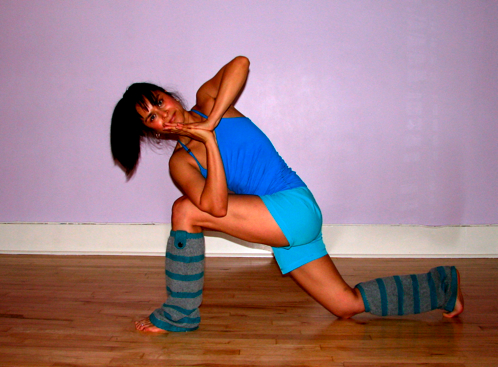
Revolved Utthita Parsvokonasana. I wouldn’t have needed the leg warmers in Thailand. Image thanks to www. elsiesyogakula.com
One morning I was struggling to lift my back knee in the twisted version of Utthita Parsvokonasana. Wobbling ridiculously, bringing my palms together in prayer, attempting to open my chest upwards, I sensed Michel approaching me.
Now imagine this: A cheeky Frenchman in his seventies, over six feet tall. He’s got steely blues eyes and the ability to make me laugh simply by calling me ‘Fromage’ on account of the cheese jokes we both enjoyed over meal times. But this time he looked deadly serious. There I was twisting, wobbling and sweating, trying to stay focused.
He crouched down by my side and brought his face very close to mine. He stared into my eyes and said, “You are better than you think you are.”
Immediately I lost it. Hot tears streamed down my face. My pose went out of the window.
It’s funny, I’ve listened to a podcast recently with Ryan Spielman and other Mysore teachers where they say that when you see someone practicing on a mat, that’s the real person. When people practice, it’s an opportunity to see the person as they really are – their true self – compared to the person you may have a chat with at the end of a class.
Michel knew that I needed to hear those words. And for this, I am grateful.
Who would you like to say this to?
“We have to learn how to be non-violent towards ourselves. If we were able to play back the often unkind, unhelpful and destructive comments and judgements silently made towards our self in any given day, this may give us some idea of the enormity of the challenge of self-acceptance.
If we were to speak these thoughts out loud to another person, we would realise how truly devastating violence to the self can be.
In truth, few of us would dare to be as unkind to others as we are to ourselves.”
Traditionally on 14 February we focus our attention on someone that we’re ‘in love’ with. But this year you may like to widen your remit. We all could do with some love – on this day and throughout the year – and so I’m going to share a meditation with you.
This meditation cultivates ‘loving-kindness’ or as Buddhists say, ‘metta’. It’s based on a series of phrases that open your heart and develop love towards everyone, including yourself.
With a loving heart, all that we attempt and encounter will open and flow more easily and we’ll be happier and more loving.
Loving-kindness meditation
You might like to repeat each step for a few minutes whilst sitting comfortably, or even just focus on a step for a week or so if you have a regular practice.
You could also repeat the phrases as you go about your day – queuing in the supermarket, waiting at traffic lights, on the way to work – or in long held yoga poses.
Start by bringing attention to yourself and breathe gently. Mentally repeat the following:
May I be filled with love.
May I be free from harm.
May I walk the earth in peace.
This particular wording works for me. You can adjust the phrases in any way so they resonate with you. Repeat these phrases over and over again, allowing the feelings to flood your body and mind.
Now bring into your mind someone who is close to you – someone who has perhaps cared for you. Imagine them going about their day, doing their thing. And repeat:
May they be filled with love.
May they be free from harm.
May they walk the earth in peace.
For the third step, focus on a friend. Perhaps someone who you know is having a hard time and could benefit from some loving-kindness. Repeat the wording for five to ten minutes.
And now for the last step, bring your attention to someone who you’ve found harder to love. You may know them well, or perhaps you’ve only met them briefly and exchanged terse words. For me right now, a traffic warden springs to mind. I’m sure they’re a very nice person… Again, repeat the wording for five to ten minutes.
During the meditation you may notice a range of emotions rising. These emotions may be very contrary to loving-kindness. Whatever comes up, it’s ok, and just breathe, repeating the phrases.
It might not feel right for you to start with the focus on yourself. Again, that’s fine. You may prefer to bring your attention to yourself at the end. No problem.
I find this a really nice practice. It cultivates love and compassion for everyone on earth and banishes negative emotions.
I’ll be using this practice in a yin/yang yoga workshop I’m teaching tomorrow in Harpenden, Herts. If you’d like to come along, have a look at the workshops page for full details.
I’m keen to hear your thoughts on this practice. Feel free to comment below.
“We have to learn how to be non-violent towards ourselves. If we were able to play back the often unkind, unhelpful and destructive comments and judgements silently made toward our self in any given day, this may give us some idea of the enormity of the challenge of self acceptance. If we were to speak these thoughts out loud to another person, we would realize how truly devastating violence to the self can be. In truth, few of us would dare to be as unkind to others as we are to ourselves.”
A few years ago I went for a job interview at The Life Centre in London. One of the questions I was asked was: “How would you describe yin yoga to a prospective student?” I said I had no idea. I’d heard of it but hadn’t practiced it. Suffice to say, I didn’t get that job.
And now, here I am waxing lyrical about the wonders of yin yoga.
You may never have heard of yin yoga, or perhaps like me during that interview, you’ve seen it on studio schedules but haven’t ventured any further. You may have been to my monthly Hertfordshire yin yoga workshops but it’s fair to say that it’s a wonderful, nourishing practice. I’m biased, of course, but here are my five reasons why:
1. Yin yoga teaches acceptance
When you’re in a pose for a minimum of five minutes, you can’t push it. If you do, you’ll regret it. So it teaches you to stay where you feel something, but not too much – not trying to inch your forehead closer to your shins in a forward bend. And anyway, over the duration of the pose, your body will open and you’ll naturally go deeper. No pushing, no judgement, just accepting.
2. Yin yoga cultivates a beginners mind
The postures have different names in yin yoga. For example, pigeon pose is called ‘swan’. This encourages us to approach each pose with no hang-ups about how we’d ‘usually’ do the pose in a yoga class.
The mind of the beginner is empty, free of all habits of the expert, ready to accept, to doubt and open to all possibilities.
Suzuki Roshi
3. Yin yoga creates space
When we sit in a yin pose, we create space in our bodies, in our minds, and in our day-to-day lives. On a physical level, our connective tissue surrounding our joints starts to become more malleable, improving our flexibility.
A reading from Reggie Ray covers this aspect nicely:
Here’s a teaching that Chögyam Trungpa gave that has changed the way a lot of people look at their work lives: learn how to invite space into your worklife. The space itself will actually accomplish most of what you need to do. In the form of helpful people turning up, auspicious coincidences… And in so doing, you are not only opening up your self, you are opening up the world. It becomes a dance. It’s no longer your job to sit there for 10 hours doing your thing, it’s to respond to the way the world wants things to happen. It’s de-centralized.
This has felt particularly apt for me over the past few weeks. Thank you, world.
4. Yin yoga achieves balance
The weekly grind can get you down. We’re always watching the clock. We’re getting children to school/clubs on time, rushing for the train, keeping our bosses/partners happy, I could go on.
We’re also always on the go when we do finally relax. TV keeps our minds active and we also stay busy when we exercise – going to the gym, running, cycling – or even through more energetic forms of yoga such as ashtanga and vinyasa flow. They all generate heat and get you moving.
This is all great, but we have to make space to be still and surrender.
Yin provides this balance. Being still can be hard but it’s necessary to counter all the busy-ness in our hectic Western lives.
5. Yin yoga is about awareness
When we practice yin yoga, it’s inward focussed. We start to notice sensations within, and naturally you’ll find that you start to watch your mind. We notice our thoughts – whether they’re positive or negative, linked to the past or the future, and whether they’re recurring. It allows us to connect within.
So there you go. There’s my five reasons. Perhaps you’ve encountered similar things if you’ve practiced yin yoga. Feel free to leave your observations below.
I teach weekly yin yoga classes at Bermondsey Fayre, London SE1; The Yoga Hall in St Albans; and from 25 February I’ll be starting a weekly class at BAYoga Studio in Berkhamsted. More details on the class schedule page. I also teach monthly yin yoga and yin/yang workshops in Hertfordshire.
I thought you might be interested to read an article I’ve written for namaskar yoga magazine, based in Hong Kong. It’s a review of my 500 hour training course and I wrote it soon after graduating. It’s now been published.
Happy reading!
500 hours of Absolute Michel Besnard
A personalised approach
namaskar – January 2014
I was sitting at my desk one grey winter’s day in London within earshot of Big Ben but my mind was elsewhere. A friend had just emailed me a link to the Absolute Yoga website and I was engrossed in reading about the 500 hour teacher training with Michel Besnard at Absolute Sanctuary, Koh Samui.
“Are you ready to take your teaching to the next level?” asked the website. I knew I was. I’d been teaching part time for two years but I felt I needed more confidence to make the transition to teaching full time. The promise of crystal clear turquoise sea and soft white sand lured me too.
Fast forward six months and I’ve now graduated from the training. It’s been an amazing journey. My 13 fellow students came from across the globe – from California to Japan – and Michel Besnard was there for us along the way.
The five-week course was intense and varied. Every day started with a two hour pranayama and Ashtanga Mysore self practice. Some of us had an established Ashtanga practice whereas others – like me – came from different schools and so Michel spent the first week getting us all up to speed.
As the weeks progressed, our morning practices became more personalised. What I particularly appreciated was Michel’s knowledge of both Ashtanga and Iyengar – he’s spent years in India training with both Mr Iyengar and Sri Pattabhi Jois. We used props and he emphasised doing the asanas in a way that suited our own bodies.
He also believes all students should practice elements of the second series. With the primary series focusing on forward bends, back bends such as salabhasana and dhanurasana provide balance in our practice.
Over the weeks, the morning practice continually pushed me. Through plenty of sweat and occasional tears, Michel was there to offer support – and not just by providing physical adjustments.
The rest of the day we learnt about a range of topics. Michelle Lam, a Hong Kong physiotherapist, spent five days teaching us advanced yoga anatomy, we covered Acroyoga and Yin yoga, and we had Carlos Pomeda show us the wonderful world of yoga philosophy. Lucas Rockwood provided many useful insights into the business of yoga and we honed our presentation skills with Akash Akaria, a public speaking expert based in Hong Kong. Suffice to say, the teaching faculty were excellent.
Absolute Sanctuary was a great venue. The infinity pool and steam room were popular for soothing our stretched bodies and we enjoyed watching the stars overhead.
Can you spot a familiar face in there?
For me, Michel and his teaching assistant Roslyn made the experience truly special. Their good humour and passion for yoga were ever-present during the course.
With Michel’s favourite phrase being “who cares” he taught us the lesson of acceptance: accepting our bodies and our practice. And where we are today is exactly where we’re meant to be.
Having graduated a few days ago, many of us have flown home to our studios and students, eager to share our new knowledge. I too am looking forward to heading back to London and starting my life as a full time teacher but memories of my 500 hour training will stay with me forever.
Clare has taught yoga in London and Hertfordshire in the UK for the past four years. She completed her 500 hour training with Michel Besnard in Thailand and specialises in teaching Yin yoga. As well as teaching, she is a regular contributor to yoga magazines and you can read her blog at www.shantayoga.co.uk/blog/.
—
Have you studied with Michel? What memories do you have of your time together? Feel free to leave your comments below.
Or if you’re interested in finding out more about him, have a read of this post from during my teacher training.
There’s this Sivananda chant that one thing and another has led me to think about this last week or so. It’s called Song of Will and contains these lines:
I am that I am, I am that I am
I am neither body nor mind, Immortal Self I am
I am not this body, this body is not mine
I am not this mind, this mind is not mine
I am not this prana, this prana is not mine
I am not these senses, these senses are not mine
I am not this intellect…
I am not these emotions… and so on.
But what on earth is it all about? Surely I am this body. Surely I am my senses. It’s all me, right? Wrong!
I was at one of Norman Blair’s yin workshops last weekend and he was talking about ‘WMB Syndrome’ where WMB stands for ‘Want Madonna’s Body’. I’m pretty sure he’d made it up. Some people may practice yoga asana with this as their goal but it’s not just about that.
It’s about learning to relax, to let go and actually detach from the body, the mind and the senses i.e. all these aspects of ourselves that are actually just our ego. This concept of ‘I’ and ‘my’ is totally false. It’s our ego talking.
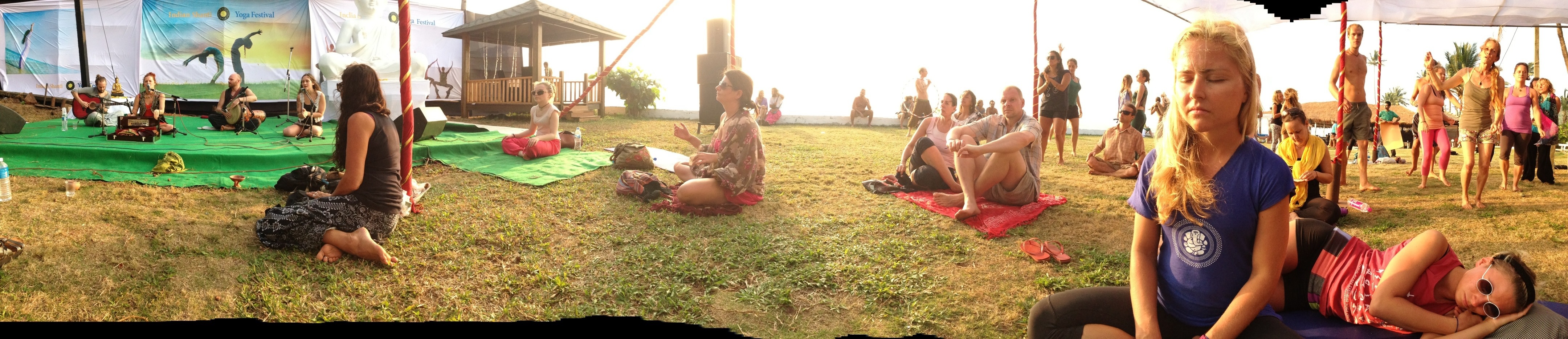
When I was in Goa recently at the Indian Shanti Yoga Festival, I listened to a talk about yoga ‘vedanta’ or philosophy. The teacher said how we wrongly identify with the ego but actually we can detach to discover the ‘Self’.
By practicing yoga – in any of its forms: bhakti, jnana and so on – we’re working to reduce the ego and uncover our true nature.
We say, “I am this” or “I am that” but how do you know that you’re sad/happy/tired etc? How do you know that food is hot? Because your mind is telling you. But you’re not your mind.
Our mind naturally always looks outward and it’s always searching for fulfilment, happiness, whatever you choose to call it. But real spiritual life and happiness is within. Clichéd I know. We mistake our thoughts and emotions for being ‘us’. But we are actually unchanging and this is the ‘Self’ or ‘atman’ of Vedanta.
I’ve always found this quite a hard concept to get my head around and I most definitely don’t have all the answers. I’m still learning all this stuff.
However, I watched this TED talk with Jill Bolte Taylor the other day (another gem of Norman’s) and she helps to explain it. She’s not a yogi or a guru by any means. She’s a neuroanatomist (I think that means she’s a brain scientist) who suffered a stroke and witnessed this divide of Self and ego. It’s amazing and well worth watching. Enjoy…
Earlier today I had my last yoga practice in Goa. I was on the roof of a one-storey building – the kitchen for the beach huts where we’re staying. As I went through my standing postures, an old bloke was shimmying up the surrounding coconut palms, sending ripe coconuts crashing to the earth below. I faced the ocean and breathed with the waves.
Tomorrow we leave Goa and head to Mumbai for two nights before flying home to London. I’ve been thinking about the yoga I’ve practiced over the last two weeks. Here are some things I’ve learnt and perhaps you’ll find them useful too.
Drop-in classes: a mixed bag
You just really don’t know what you’re in for. On Christmas Day morning I went to a led Ashtanga class with an Indian guy called Deepak. His adjustments were a little unconventional (verging on dangerous) and I felt my body tense whenever he moved near me. He was as bendy as the bendiest bendy thing and didn’t seem to show much empathy for Westerners in their first ever yoga class.
Other classes were lovely but just going to one class then trying a different class the next day doesn’t allow a student/teacher relationship to develop. Consistency is key.
Immersion is good
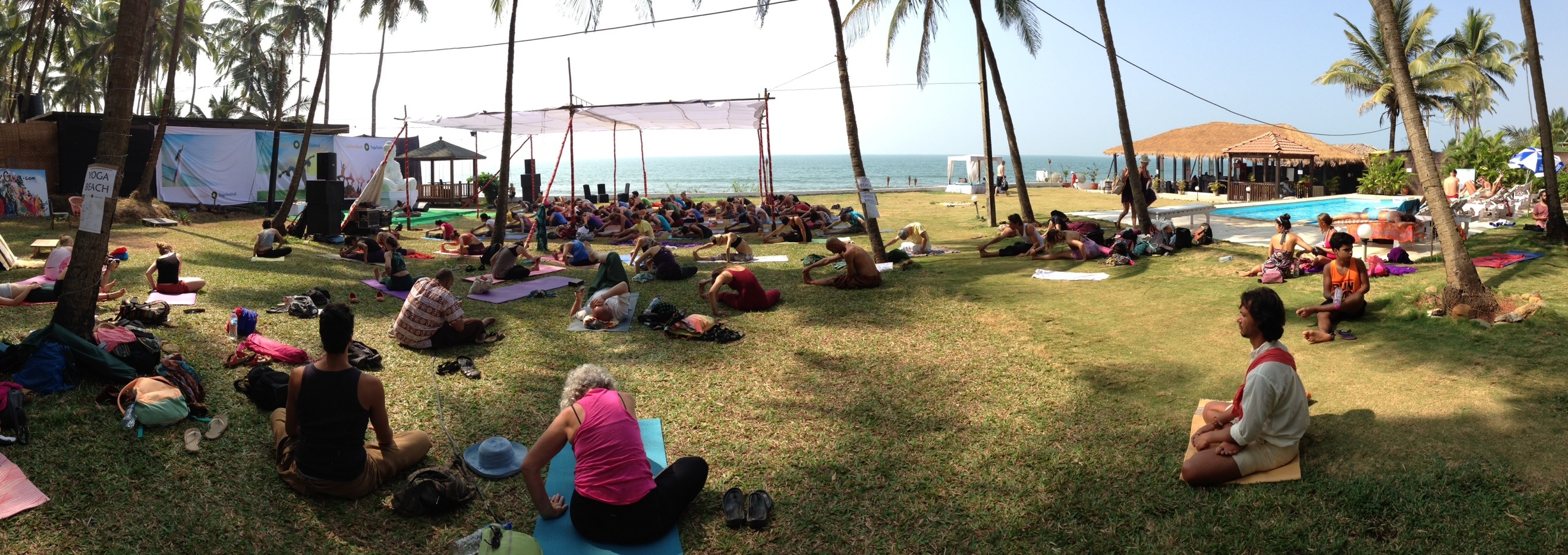
Katharine and I stumbled upon the Indian Shanti Yoga Festival and it became one of the highlights. At a plush beach resort in Ashwem, we spent three days surrounded by yoga addicts and a schedule that ran from 8am to 10pm… all for £25.
I reconnected with Sivananda yoga through classes with Nataraj, the Director of the ashram in Kerala where I’ve spent time previously. Witnessing him in his baggy Sivananda yellow t-shirt and white trousers just made me feel so happy. He looked a bit at odds with girls wearing tiny lycra shorts but the atmosphere was very welcoming and inclusive.
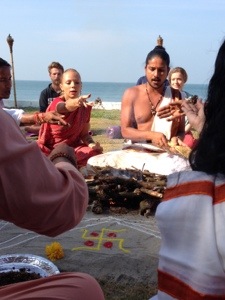
There was a lot of bhakti (devotional practices). The festival opened with a homa (fire ceremony) to Lord Ganesha. We all offered something to the fire – something we wanted to cast aside for 2014. Swamis from various Indian ashrams taught classes and led the chanting of Sanskrit bhajans.
(Anand led the Ganesha homa.)
(Swami Sugoshananda: “Everything happens as planned and it is for our own good.”)
I also went to a Bhagavad Gita talk, taught by an elderly New Yorker with a huge white beard, long hair and piercing blue eyes. He reeled off the slokas (verses) in Sanskrit. Hearing the words of Krishna to Arjuna with his accent: “Hey Arjuna, so you gotta fight people you care about. But you just gotta do your duty!”
Acroyoga is awesome
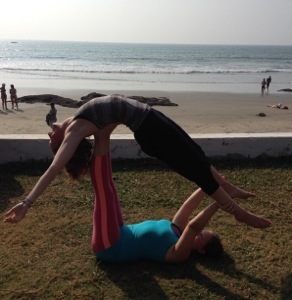
Acroyoga founder, Jason Nemer, taught at the festival.
With one person being the base, another the flyer, and another the spotter, we did some therapeutic flying. We practiced giving each other massages in ‘folded leaf’ and worked on backbends suspended in the air in ‘high flying whale’. We did handstands holding onto the backs of your partner’s ankles while they were in a high plank.
(Me being a high flying whale.)
I like the philosophy behind the practice. It’s about building trust and confidence through letting go. The flyer has to resist any urge to control and you are totally in the hands (and feet) of your base. It’s playful, fosters closeness and you learn a lot about your partner. The sessions open and close with kirtan – chanting in a circle, developing togetherness.
Jason will be teaching five days of acroyoga at Triyoga in London later this year.
The final day included four hours of Thai Yoga Massage run by the acroyogis. Thai massage is seen to be a complementary practice to the more acrobatic side. I like this. It’s the yin and yang idea. The massage is the yin (calming, cooling, slow, soft) and the acroyoga is more dynamic, energising and fast-paced.
Summing up
Some of my most enjoyable yoga moments have been my self practices but I’m also looking forward to going home and getting back to classes – both teaching and being a student.
I know this trip has been about relaxing, spending time with my sister and also doing some yoga, but if I were to return to India for yoga, I’d do a period of study with someone who can help develop my practice. I’ve got my eye on David Garrigues’ intensive in Kerala in 2015, a trip to Mysore or even a retreat with David Keil at Purple Valley in Anjuna.
That’s the joy of yoga. There’s always more to learn and India is always calling.
Classes start back in London and Hertfordshire from 12 January and the first yin/yang workshop at Breathing Space in Harpenden will be on 18 January. My first BAYoga Studio yin workshop is on 1 February.
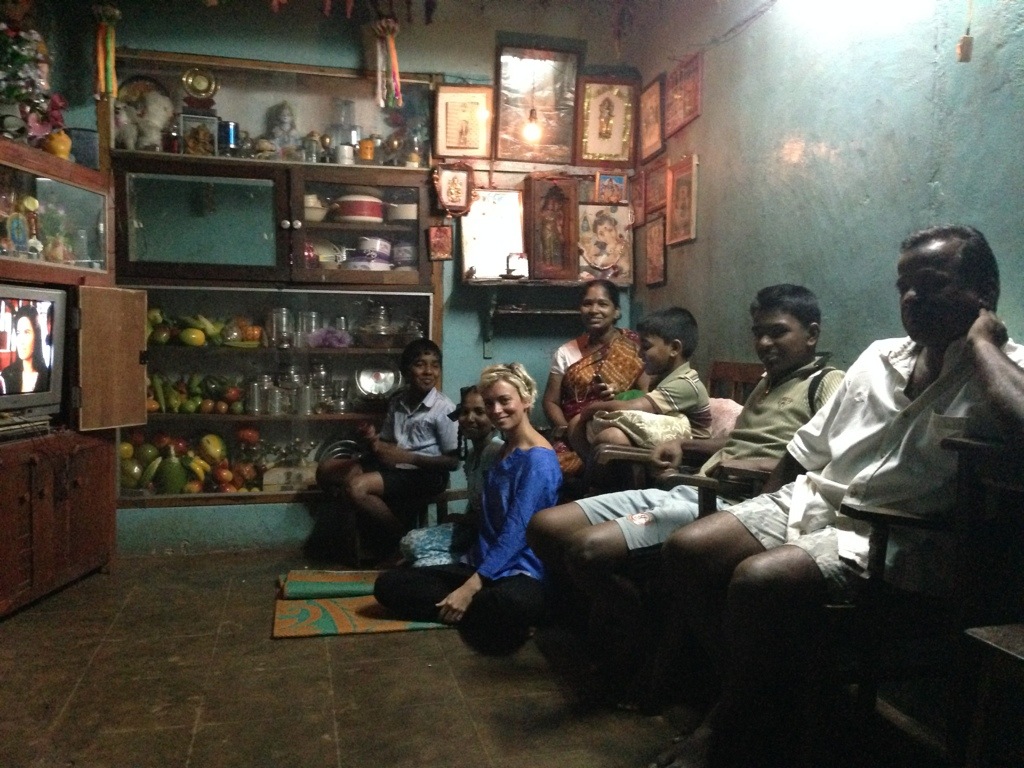
For anyone who read my blog while I was away last year, you may remember talk of my adopted Indian family – a local family whom I had the honour of befriending via daily harmonium lessons with the grandad – ‘Babaji’. Over three weeks, my daily visits lengthened and became the highlight of my stay in Arambol. Read last year’s blog post.
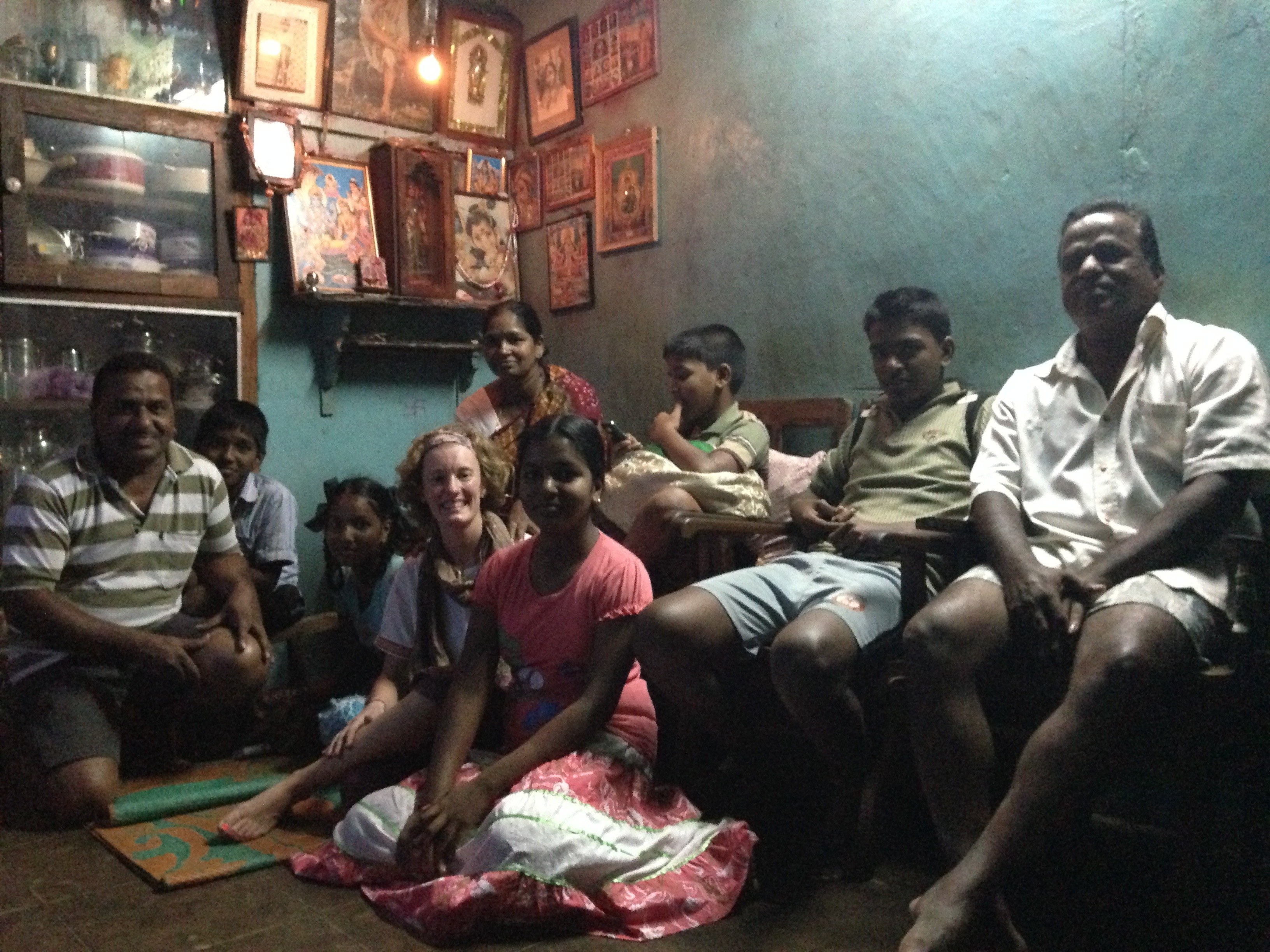
In the house, the sons (Chandrahas and Srinivas) live with their parents (Maji and Babaji), their respective wives and an assortment of children. I am yet to totally work out whose children are whose.
Maji, though wizened and hunched, definitely rules the roost. She’s always been painfully shy around me though I have gathered that she likes my clothes and thinks I’m respectful. I bring my hands in prayer and bow slightly when saying hello and goodbye to her. Points to The Wener.
When I knew I would be returning to Goa, one of the first things I did was send them an email.
Yesterday we popped by for tea and a spot of Indian TV. Here are some of the highlights:
Chandrahas provided a TV commentary: “This is comedy programme. You can tell by the size of his moustache.”
I asked why so many Indian men had moustaches. He said it’s a sign of manliness. I asked why he didn’t have one. “It would be grey in colour” came his reply. The children laughed. They understood more English than they felt comfortable speaking.
We also watched a short programme where actors played parts of Hindu gods and goddesses. Ganesha looked fetching with a trunk down over his stomach and Shiva was very stern with his hair piled up on top of his head.
Then Chandrahas told us we were watching a drama about some families. It sounded like Eastenders but with more exaggerated expressions and dramatic music. It seemed to be a family favourite.
Tejas stayed very quiet but opened up talking in English about his favourite subjects: WWF wrestling and cricket. He informed us that England is losing in the Ashes. “It is a total whitewash.” He is about 10.
Sweda, Chandrahas’ wife, was not allowed into the living room as she had her period. She sat on a chair in the doorway and craned her neck round, eager to be included. She wasn’t allowed to touch us. Srinivas’ wife affectionately held Katharine’s hand as we sat. There was a lot of love in the room.
A neighbour popped by and looked taken aback to see the two of us sitting there. Sweda said, “She is asking how we know you. She is very surprised that you are our friends.”
Siddesh asked Katharine if someone coloured her hair. She was told it looked like Lady Di’s.
(Lady Di and the Dabholkars)
Maji brought us chai and Indian sweets in what looked like the family’s finest crockery. We drank the tea and politely ate the sweets – homemade laddus. For anyone unfamiliar with laddhus, these are balls of what Katharine described as compressed sand. I’d say they’re a bit like sawdust. You need to drink tea at the same time otherwise they coat the inside of your mouth in a claggy paste.
We ate them very slowly, nodding, making the right noises and smiling our appreciation. “You like them?” asked Chandrahas. We nodded and smiled lots. Out came two more. We ran out of tea.
After two hours Srinivas took us home on the back of his motorbike. The family waved us off.
On Monday, we’re going back for dinner and then we’ll all go to their temple for a puja (ceremony). Sweda told us that her period will be finished by then. I said that I look forward to being able to hug her.
It was so lovely to see them all again. Babaji held my hand as we said goodbye and said little. The family seemed much more relaxed than when I spent time with them last year. It felt like they were just seeing old friends and were less ‘on show’.
They made us feel so welcome and I can’t wait to go back on Monday. We’re not entirely sure what we’re in for but we know it’ll be memorable.
We’ve been lucky to get a glimpse into everyday Indian family life. They’re kind hearted and a truly wonderful family.
I’m in Goa for Christmas and New Year with my sister Katharine. We’re spending time on the beach and doing some yoga.
For the first five days, we’ve been in southern Goa in Patnem. I’ve been to a few yoga classes and hung out with some friends from home.
Today we left for North Goa, Mandrem to be precise. Both Katharine and I know that train journeys are always an experience and it felt time to get in touch with the real India – away from the British families and the music of Amy Winehouse and Bob Marley that we’d been hearing incessantly. The day proved to be a true Indian journey in every sense.
The plan was to get a taxi for an hour to Madgaon station – the main train station in Goa – and then get a train north to Pernem. From there, it was a short hop and a skip to Mandrem.
Trains
We were told that there was a train from Madgaon at 2:40pm. This was backed up by the internet.
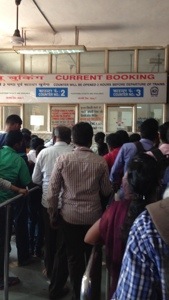
We arrived at Madgaon station and got in the queue for tickets. Almost instantly I had to tell a bloke to get behind us as he tried to queue jump. For the next 30 minutes he pressed his body up against my rucksack on my back and complained that we were leaving too much of a gap in front of us. Indian men have no sense of personal space.
(Ticket office. It looks quite calm in a photo. It wasn’t.)
(Katharine on the platform)
A young girl was ahead of us in the queue. She had a beaming smile and big brown eyes. She asked us where we were from and made polite conversation in impeccable Indian English.
Men queue jumped ahead of us. Sweat trickled down my legs and arms. People shouted and gesticulated. And then we were at the counter. Katharine got jostled out of the way and suddenly all these hands holding filthy dog-eared rupee notes forcefully pushed their way under my arms, over my shoulders and through the tiny hole in the grubby perspex to the cashier.
Whoever was the loudest appeared to get served next. “Two for Pernem” I said in my biggest voice. By the fourth time I’d said it, I had her attention.
“Madam, train is at 6pm.”
“There’s a train at 2:40!”
“No madam, 6pm. Come back later.”
And with that, I was consumed by the crowd and found myself cast aside. Buggery bugger. We double checked at the information counter (more jostling). 6pm it was. The young girl found us and stood nearby while we discussed our options.
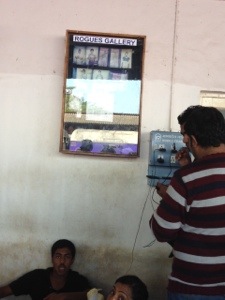
(Madgaon station ‘rogues gallery’. I’d like to start a campaign to get one of these at Harpenden station.)
Automobiles
Cheated of our train journey, we found ourselves in the queue for the prepaid taxis. The board said that the fare was the equivalent of £15. Our train tickets would have been 30p each. We grumbled.
Again we were at a counter.
“We want to go to Madrem.”
“1750 rupees.”
“But the board says 1500 rupees.”
“Diversion for a festival. It will take longer. The price is 1750 rupees.”
We said we wanted to pay the board price. They stood their ground. We stood our ground. The locals joined in. Why do they always do that?
We begrudgingly accepted and got shown to our taxi. We questioned our poor elderly taxi driver. I’ve never seen such pronounced cheek bones in my life. I don’t think he was in possession of his teeth. He didn’t know of any diversion. Everything seemed to confuse him.
The faff continued. We gave in and off we drove.
Plain sailing
There is always a part of me that mistrusts these exchanges. Are they trying to get the better of us naive foreigners? You hear of so many scams that it makes you sceptical.
I remember turning up jetlagged at chaotic Delhi station about ten years ago with my dad to be told by an ‘official’ that our train was cancelled and we needed to give him our tickets. He was lying and we knew it.
Travelling around India on public transport is tiring and often doesn’t go according to plan but it’s also the most rewarding part of visiting the country. In Goa it’s easy to remain in your beach resort eating chips. Or you jump in a taxi and stay in your own little cocoon.
I’d still say that I love train travel in India. Chatting to families on platforms, sharing snacks with locals in your carriage, asking the chai wallah for a cup of that boiling sweetness, watching the vibrant countryside slide by hour after hour. Yes the toilet might be a hole in the floor through which you can see the speeding tracks below, but believe me, these are the magical moments.
This country has me under its spell. It teaches you patience and acceptance and tests you every day. Don’t ask me why but I love it.
Have you been to India? Any of this sound familiar? Or maybe I’ve made you think that this country isn’t for you. Feel free to comment below.
A few months ago I was asked if I’d like to do an hour of yoga in the new Sweaty Betty St Albans shop on the day of the opening. I didn’t say yes immediately as various thoughts were going through my head. I felt torn and here’s why:
4 reasons AGAINST doing yoga in Sweaty Betty St Albans
1. The practice of yoga is about reducing your ego i.e. that sense of ‘I’ and the self. We associate ourselves with everything that’s about the ego – for example: what we look like, what job we do and how we behave. By practising aspects of yoga – the physical asana practice, chanting mantras, and doing selfless service (doing things without an expectation of reward) – we are reducing our ego and connecting with our inner nature i.e. who we really are.
Surely doing yoga in the middle of a shop is simply drawing attention to yourself and boosting that sense of self, fuelling the ego.
“Always watch that ego. Control of the mind and annihilation of the ego are the essence of all yoga disciplines.”
Swami Vishnudevananda
2. Linked to this, humility is the greatest quality for a yoga teacher. As a yoga teacher, it’s about passing on the teachings you’ve received in a humble way and your focus is on your students, ensuring you give them your energy and attention.
You could say that ‘performing’ yoga whilst being surrounded by gawping onlookers instead of students isn’t very humble.
3. Sweaty Betty can be seen as commercial. It’s a business – a successful one – and it makes a lot of money. Indeed, I was reading an article the other day about how they’re starting to give Lululemon a run for their money having opened their first stores in the US.
Should yoga be about making money? It’s a debate that’s been had time and time again. The ancient physical practice of yoga postures in India came about as a way of preparing your body for long periods of seated meditation. It’s really only since the West has got hold of yoga that the physical practice has become what it is today and it’s much more commercial as a result.
4. When you practice yoga, it shouldn’t be about what clothes you wear. This has been drilled into me from my Sivananda background where you wear the baggiest clothes ever and anything goes. Branded clothes are yet another way of increasing our sense of ‘self’. What do those clothes say about us?
However, I must say that now that I practice more ashtanga, clothes are much more important. You get pretty hot and you want that sweat to be taken away from your body quickly. I’ve learnt that technical clothes have their benefits.
4 reasons FOR doing yoga in Sweaty Betty St Albans
1. It’s a chance to meet new local yogis. I have my familiar places where I like to practice. It’s a chance to meet other people who are into the same things.
2. Taking me out of my comfort zone, trying something new, practicing in a new location… I might find it challenging in different ways. I might learn something as a result. We can get stuck in a rut with our practice.
3. You get given free clothes. I know, I know, they give you the free clothes so you’ll wear them when you teach and then students will say, “Ooooh that’s nice. Where’s that top/those leggings/jumper from?” But you know, their clothes feel nice, they’re flattering and yes, I like clothes. So shoot me. Ok, don’t really shoot me. That would be violent and yoga isn’t big on that. You can see that I still have some way to go on the whole ego front.
4. Finally, it takes yoga to new audiences. If you saw someone doing sun salutations for the first time, you might stop and watch. You might not have expected to see such a thing whilst you’re having your normal Saturday morning wander around the shops.
It might encourage you to find out more about yoga. It might even make you go to a class. Yes, it would be great if it was one of my classes but I’d be happy if was any local class.
It’s about raising the profile of yoga. The more people that practice, the more the world will be a happier and healthier place.
And so I did it.
Doing yoga at Sweaty Betty St Albans
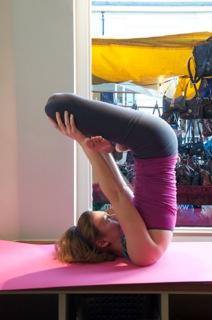
How much is that pindasana in the window? The one with the downward-moving tailbone.
From 11-12am on Saturday I found myself on a yoga mat in the window of a shop. It was weird and it was fun.
Sun salutations were interesting as you couldn’t stretch your arms out to the sides as you’d simultaneously hit the glass and take someone’s eye out. At times I felt I was showing the shoppers of St Albans a little too much of my bottom.
I did an hour of ashtanga primary series. In ashtanga there’s talk of ‘drishti’ – where you look during each pose. It might be towards the tip of your nose, your knees, or elsewhere on your body. Also there’s the practice of ‘pratyahara’ – withdrawing your senses and going more inward. I tried to keep both practices in mind during the hour. It was hard.
At one point I noticed an elderly couple standing watching on the pavement. Then there were families with children, and teenagers taking photos on their phones. Drishti… pratyahara… drishti.
I thought about those new audiences. Those new potential yogis in the waiting.
It felt great to share the practice with people who weren’t familiar with it. The staff at the shop were lovely and I was made to feel very welcome. I saw some familiar faces and I met
some new ones too. I was aware of my ego and tried to keep it in check throughout. I was
Urdhva Padmasana – part of the ashtanga finishing sequence. Images thanks to Sweaty Betty.
just doing my practice.
I (and my yogi friend April) might even be doing some guest instructor things there next year so keep an eye out.
Would I do yoga in a Sweaty Betty shop window again?
Yes I would. I’m all up for having a bit of fun and trying something new. And you know, if I wasn’t up for trying something new, I’d never be teaching yoga.
What do you think about this? Would you have done it or would you have run the other way? All comments are valid…